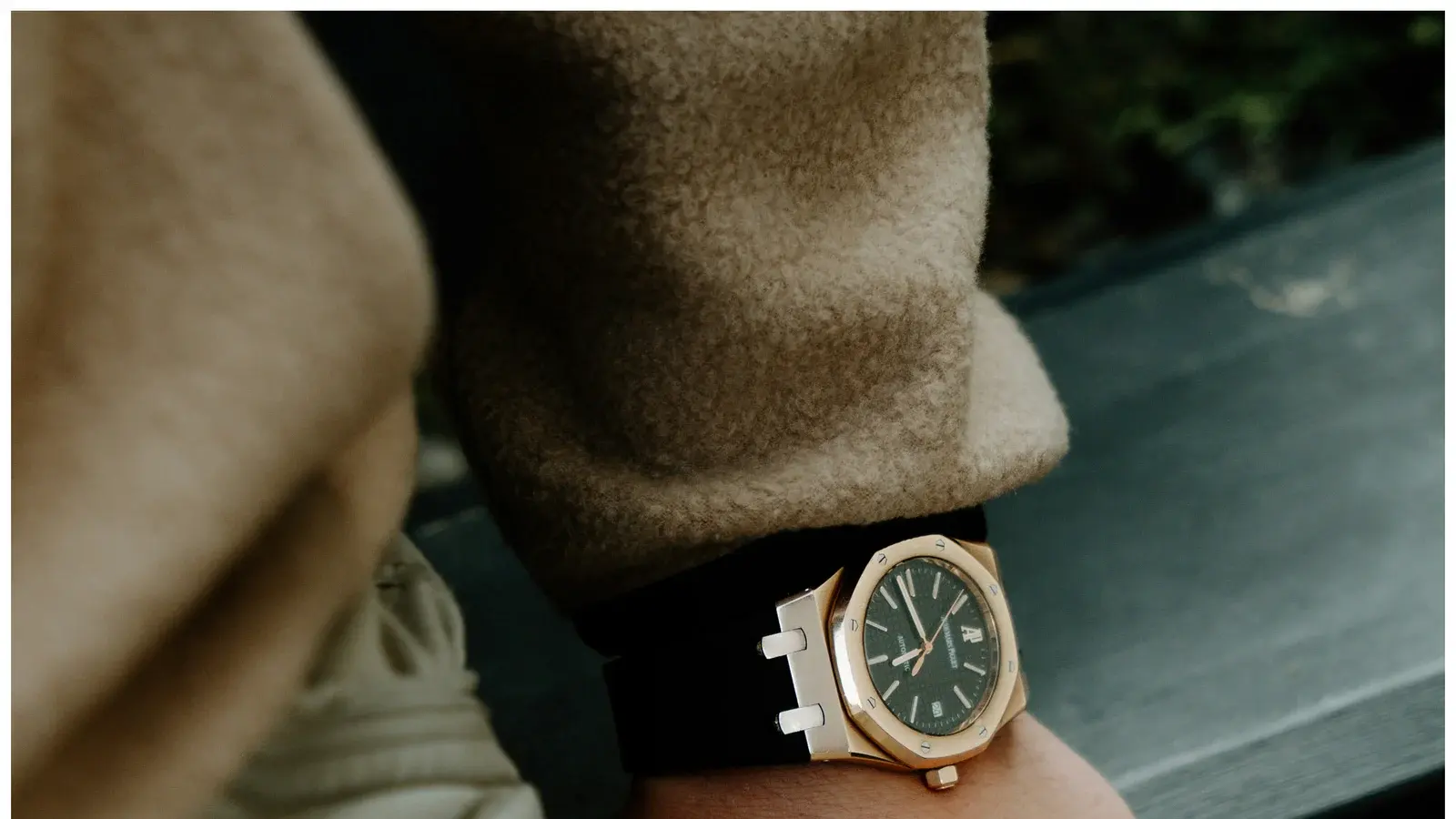
Audemars Piguet Royal Oak: The Complete 2026 Guide
The Royal Oak remains the most culturally significant luxury sports watch.
The Royal Oak remains the most culturally significant luxury sports watch. We examine every key reference — 15500, 15510, Offshore, and beyond.
By NorwegianSpark Editorial — written with AI assistance and reviewed by the NorwegianSpark SA editorial team.
The Audemars Piguet Royal Oak was introduced in 1972 and reached its fifty-fourth year in 2026 with its cultural position undiminished. Designed by Gerald Genta, the same hand that later shaped the Patek Nautilus, it was the first luxury sports watch in stainless steel to be priced above the gold watches sitting next to it, which at the time looked like commercial recklessness. The market disagreed for several years and then changed its mind permanently. This guide covers the references that matter and what to check before buying one.
The 1972 decision and why it worked
The proposition was genuinely strange: a steel watch, large by the standards of the day, with a visible industrial fixing system, sold at a price that bought a gold dress watch. It sold slowly at first. What eventually made it work was that it was not pretending to be a dress watch in steel; it was a new category, with a case and bracelet conceived as one object and finished to a standard that had previously been reserved for precious metal. Every integrated-bracelet luxury sports watch since descends from that decision.
Reading the design
Four elements define the watch and are worth learning to look at, because they are where quality shows. The octagonal bezel with eight visible hexagonal screws, which pass through the bezel and secure the gasket beneath. The tapisserie dial, a hobnail-textured guilloche pattern produced in varying grid sizes across references. The integrated bracelet, which flows from the case rather than attaching to it and tapers markedly. And the finishing itself, alternating brushed surfaces with mirror-polished chamfers along every edge, which is the most labour-intensive part of the whole watch.
Partner
Watch Gang
The 15500ST
The 15500ST in stainless steel is the reference that defined the modern Royal Oak in the last generation, at 41mm with an in-house automatic movement. It refined the outgoing model with a redesigned dial layout, an adjusted date window and a movement upgrade, and it is generally considered the point at which the 41mm Royal Oak became mechanically and aesthetically mature. Blue and grey dials are the most discussed variants. It trades on the secondary market at a premium to its retail price, though the size of that premium has moved considerably over the past few years.
The 15510ST
Audemars Piguet introduced the 15510ST as the successor to the 15500, keeping the essential design while updating case finishing details and the movement. The transition was received well, which is not always the case with a change to an icon, and secondary prices for the two references track fairly closely. If you are choosing between them, the honest advice is to handle both: the differences are real but subtle, and the deciding factor for most buyers ends up being which specific dial and which specific example is available in good condition.
The Jumbo and the extra-thin lineage
The extra-thin references, descended directly from the original 1972 watch, sit at 39mm with a much slimmer case and an ultra-thin automatic movement. Collectors often regard this line as the purest expression of the design, because it is closest to what Genta drew and because the thin case wears very differently from the 41mm. Allocation on these is the most difficult in the entire family. If the original proportions are what appeal to you, this is the line to pursue, and you should expect it to take a long time.
Royal Oak Offshore
The Offshore, launched in the early 1990s, is the Royal Oak amplified: larger, thicker, more aggressively finished, and originally controversial among traditionalists for exactly those reasons. It has since become a significant collection in its own right, strongly associated with sport and music, and it has genuine depth on the secondary market. It is also frequently easier to obtain than the core Royal Oak references. If you want the design language in a bolder register and you have the wrist for it, the Offshore is the pragmatic route in.
The women's Royal Oak
The 33mm and 37mm references, in steel and with various dial and bezel treatments, have seen substantial demand growth, and the reason is not complicated. The watch industry spent decades offering women quartz movements and decoration rather than mechanical watches worth collecting, and serious collectors noticed. The smaller Royal Oaks are the same watch, mechanically credible and finished to the same standard, in proportions that suit more wrists. They are among the more sensible entry points to the family for anyone, and the secondary market has begun to reflect that.
Case finishing, and why it matters to value
The alternating brushed and polished surfaces are what make a Royal Oak expensive to produce and what make a badly polished one obvious. Each chamfer is a defined edge with a defined width, and an unskilled polish rounds it, softening the case profile permanently. Learn to look at the bevels along the case sides and the bracelet links, and compare a candidate against images of a known-fresh example. This single check will tell you more about a used Royal Oak's condition than the seller's grading will.
Buying at retail: the authorised dealer relationship
Allocation of the most sought-after references runs through authorised dealers and is relationship-driven, exactly as it is at Patek. That means purchase history, genuine engagement and patience. Being a good client of a dealer over years is the mechanism, and there is no version of this that works in a single visit. Be wary of any offer of immediate retail access to a difficult reference, and be clear that buying other pieces to build a relationship is a real cost that should be counted in the price of the watch you actually want.
Buying pre-owned
The secondary market for Royal Oaks is deep and liquid, which is an advantage for buyers. Insist on the full set: original box, warranty card with matching serial, and any service documentation. Check the bevels as described above, check for stretch in the bracelet by holding it horizontally and looking for sag between links, and check the dial closely, since tapisserie patterns can be reproduced convincingly but rarely perfectly. Buy from a dealer who authenticates and will take the watch back, and have it independently inspected where the value justifies it.
Partner
italist
Luxury Italian fashion — Gucci, Prada, Bottega Veneta at Italian prices
Polishing, servicing and value
Never allow a general polish. Instruct any service centre in writing to preserve the original finish and not to refinish the case or bracelet, because the alternating surfaces are almost impossible to restore correctly outside the manufacture and an over-polished example is permanently devalued. Service intervals and costs follow the same logic as other high-end mechanical watches: budget for it as a recurring expense rather than a surprise. Our servicing guide covers what a full service involves and how to instruct one properly.
The counter-argument
The steel integrated-bracelet category has been the most fashionable corner of watchmaking for roughly a decade, and fashionable corners revert. Anyone buying at a substantial premium over retail is paying for scarcity plus sentiment, and only one of those two is durable. The watch itself is superb and will still be superb if the market cools; the premium may not be. If you want one, want it as a watch. If the resale is the point, understand that you are taking a position on a consumer good in the most crowded trade in the industry.
What to check before you buy
Confirm the exact reference and dial variant, since values diverge sharply between them. Confirm the set is complete and the card serial matches the case. Inspect the bevels and the bracelet for stretch. Ask directly whether the watch has ever been polished and by whom. Confirm the service history and the return policy in writing. And compare against completed sales, not listings. For the other half of this category, our Patek buying guide covers the same questions at the Geneva maison. Reviewed by the NorwegianSpark SA editorial team.
Continue Reading
More from the Journal



Continue in this collection

Luxury Destinations
Where to go and, more usefully, when — season, crowding and what closes out of it.

5-Star Hotels
What actually earns the fifth star, and which properties are coasting on one they were given years ago.

Travel Guides
Destination guides written to be used on the ground: where to stay, eat, and what to skip.