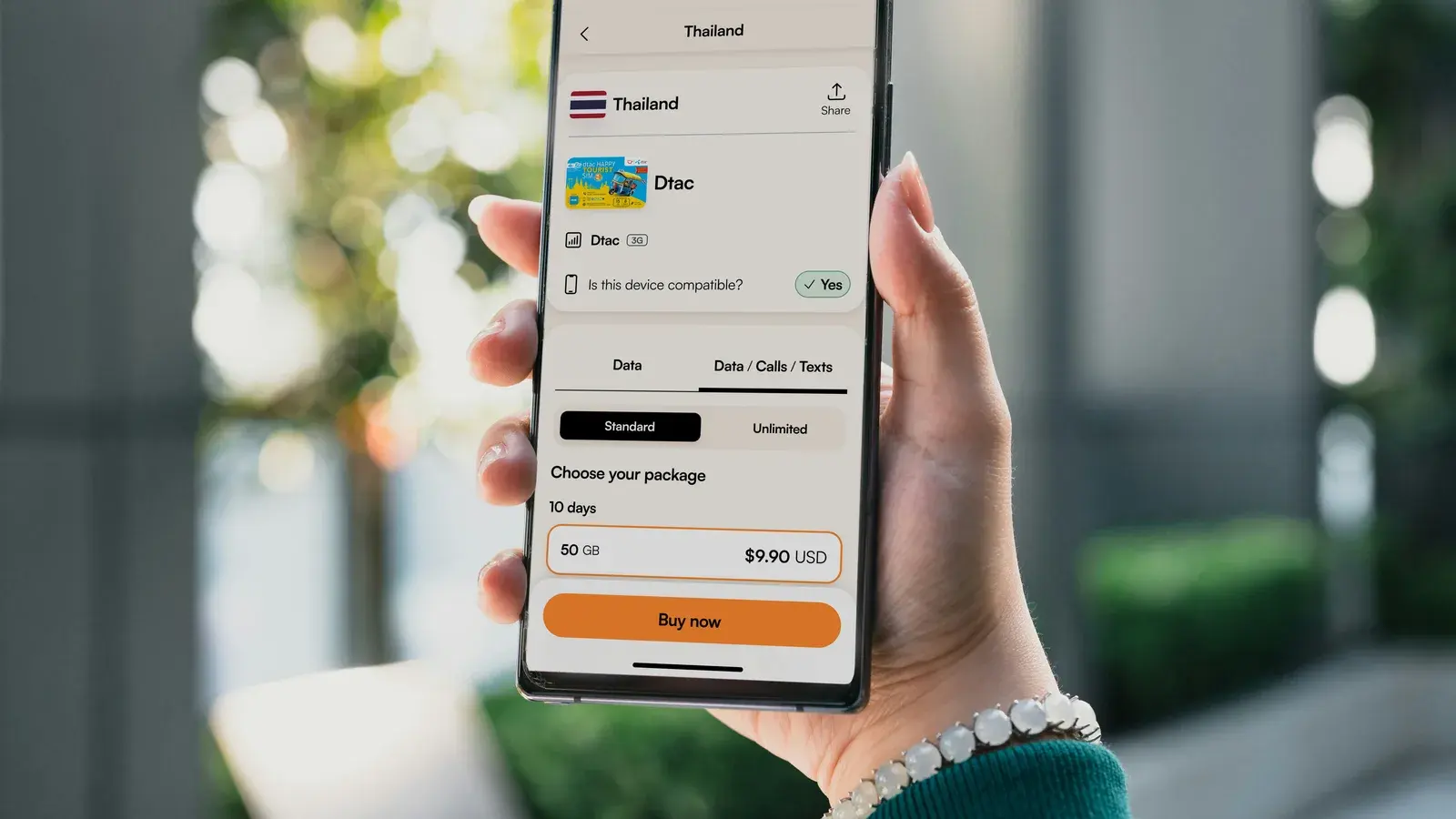
eSIM vs Physical SIM for Travel: Which Should You Use?
Why most travellers have switched — and the few cases where a local SIM still wins
Is an eSIM better than a physical SIM for travel? Why an eSIM usually wins, when a local SIM still makes sense, and the phone-number question.
By NorwegianSpark Editorial — written with AI assistance and reviewed by the NorwegianSpark SA editorial team.
For most travellers in 2026, a travel eSIM has replaced both roaming and the old ritual of buying a local SIM on arrival — it installs in minutes, keeps your home number in place, and works the moment you land. But a local physical SIM still wins in a few specific situations. Here is how to decide. If eSIMs are new to you, start with what an eSIM is.
Why an eSIM usually wins
- Convenience: buy and install online before you fly — no shop, no queue, no swapping a tiny card in an unfamiliar airport.
- Keep your number: your home SIM stays in place, so you never lose access to calls, texts and two-factor codes on your own line.
- Dual use: run your home line for messages and the travel eSIM for data at the same time.
- No lost SIM: nothing to misplace, and nothing to swap back when you get home.
Partner
Airalo
The broadest travel-eSIM marketplace — pick your country, install in minutes, land connected.
When a local physical SIM still makes sense
- Your phone does not support eSIM, or it is carrier-locked — the two requirements for any eSIM.
- You need a local phone number for calls and texts (for example to receive a local delivery or bank code), which a data eSIM does not provide.
- You are staying long-term in one country, where a local prepaid SIM's monthly bundle can beat a travel plan.
- You are travelling somewhere an eSIM provider covers poorly — always check coverage for your exact destination first.
Partner
Undercover Tourist
The number question, stated precisely
This is the difference that decides more trips than any other, and it is usually described too loosely. A travel eSIM sells data. A local physical SIM sells a local subscription, which normally includes a local number capable of making and receiving ordinary calls and text messages. Anything that travels over the internet is unaffected by the distinction — messaging apps, internet calling, email, maps all work identically on either. What only the local number can do is receive a call or a text from something that is not an app: a courier, a restaurant confirming a booking, a driver at the kerb, a domestic account that insists on a local mobile number to register.
The corollary catches people out in the other direction. Your own home number keeps working over the internet regardless of which you choose, but text messages sent to it — including one-time security codes from banks and accounts — arrive over the mobile network, not the internet. So keep your home line enabled to receive texts even when the travel data is coming from elsewhere, and switch data roaming off on that line so it cannot bill you. Or move those accounts to an authenticator app before you travel, which is the tidier fix.
What buying a local SIM actually involves
The convenience gap is wider than the price gap, and it is worth being honest about what the cheaper option costs you in effort. Many countries require identity registration before a prepaid SIM can be activated, meaning a passport, a form and sometimes an address — a process that can take anywhere from a few minutes at an airport counter to a return visit to a shop. Airport kiosks are the most expensive place to buy and the least likely to explain the tariff clearly. Coverage, tariff structure and top-up mechanics are described in the local language. And you will be handling a small piece of plastic, which means your home SIM has to go somewhere safe for the duration.
None of that is difficult. It is simply an hour of a trip, repeated in every country, and it is precisely the hour a travel eSIM exists to remove. Whether that hour is worth the price difference is a personal calculation, and the answer changes sharply with the length of the stay.
The failure modes are different, which is the underrated point
A physical SIM is portable and a profile is not. If your phone is stolen, drowned or simply dies, a physical SIM can be moved into any spare unlocked handset — a travelling companion's old phone, something bought locally — and you are connected again within minutes. An eSIM profile lives on the device it was installed on, and losing the device loses the profile with it. That asymmetry rarely matters and matters enormously when it does, which is a reasonable argument for not making a single eSIM the only route to your money and your bookings on a long or remote trip.
The reverse asymmetry favours the eSIM. There is nothing to lose in a hotel room, nothing to swap in a taxi at four in the morning, and no chance of arriving home to discover your own SIM is in a drawer in another country. On balance the eSIM is the safer everyday choice and the physical SIM is the better contingency, which is why the answer for many experienced travellers is not one or the other.
Doing both, and when that is sensible
A dual-SIM phone will happily run your home line, a travel eSIM for data, and in some cases a local physical SIM as well. The combination worth considering on a longer trip is a travel eSIM for the first days, so you land connected and can navigate to your accommodation, followed by a local SIM bought once you are settled if the stay justifies it. You get the frictionless arrival and the better long-run rate, and you never spend an hour in an airport shop while tired.
Working out where the crossover sits
There is no universal number of days at which a local SIM overtakes a travel eSIM, because it depends on the country's domestic pricing, which varies dramatically. There is a method, though. Price the travel eSIM plan that would cover your whole stay. Then find what a local operator charges for a comparable monthly bundle in that country. Add to the local option the cost of getting to a shop and the time the registration takes. Compare the totals. In markets with cheap domestic data the local SIM wins quickly; in expensive ones it may never win at all for a stay of a few weeks. Do the sum for the specific country rather than carrying a rule of thumb from a previous trip.
The bottom line
For the vast majority of trips, an eSIM is simpler, faster and safer for your number — buy it before you fly and switch it on when you land. Reach for a local SIM only when you need a local number, you are staying long-term, or your phone cannot run an eSIM. Ready to choose a provider? See the best travel eSIMs in 2026 or our Airalo review.
And if the trip crosses several countries in one region, the comparison is not really eSIM against plastic at all — it is one regional plan against a handful of local ones, which is a different sum. The best eSIM for Europe in 2026 works through that case, including the circumstances in which your existing home plan already covers you and no purchase is needed.
Continue Reading
More from the Journal





Continue in this collection

Travel Planning
Budgeting, insurance and concierge services, judged on what they do when a trip goes wrong.

Travel Guides
Destination guides written to be used on the ground: where to stay, eat, and what to skip.

5-Star Hotels
What actually earns the fifth star, and which properties are coasting on one they were given years ago.