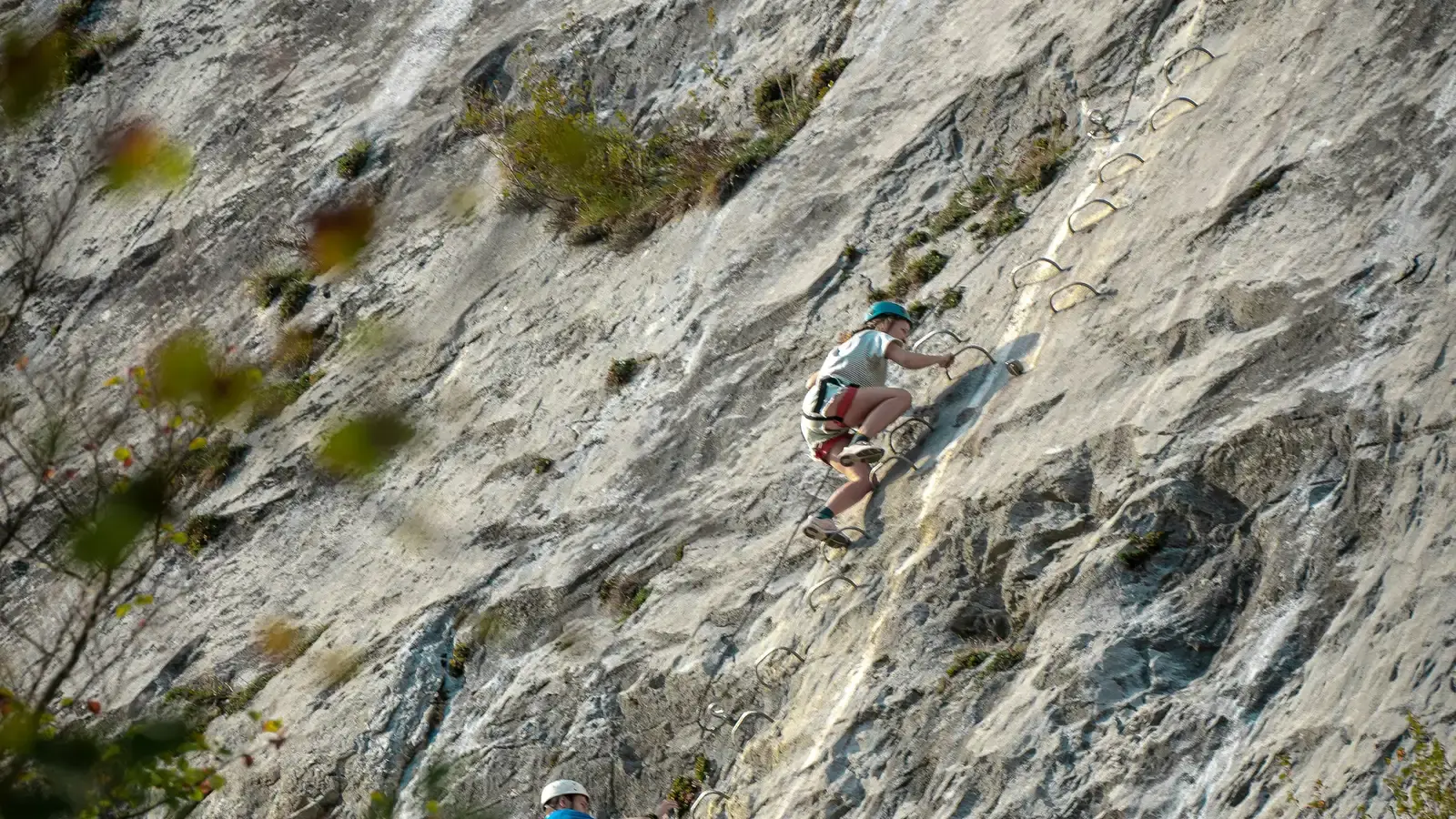
Via Ferrata in the Dolomites: What to Know Before You Clip In
The kit standard nobody reads, and the grade nobody checks
Via ferrata in the Dolomites for beginners: the certified kit and its weight range, grades that disagree, rockfall, and a first season that works.
By NorwegianSpark Editorial — written with AI assistance and reviewed by the NorwegianSpark SA editorial team.
A via ferrata — an iron way — is a route through steep mountain terrain equipped with a fixed steel cable, and often with rungs, pegs, ladders and bridges. You wear a harness and a purpose-built lanyard set, and you clip to the cable as you go. It is the most accessible route into genuinely exposed alpine ground that exists, and the Dolomites have more of it than anywhere on earth.
That accessibility is exactly why it deserves a planning article rather than a highlights list. Via ferrata removes the technical barrier to serious terrain without removing the terrain. The three things that go wrong on a first trip are almost always the same three: the wrong equipment, a route chosen from a photograph rather than a grade, and weather that was legible on the forecast if anyone had read it.
The equipment is a certified system, not a set of parts
A via ferrata set is a single manufactured item: a Y-shaped pair of arms ending in two large gated carabiners, joined to your harness through an energy-absorbing element. That element is the entire point. Fall on a via ferrata and you fall the full distance to the last cable anchor, then load the system hard. Without something to absorb that energy, the force goes into the harness and into you.
Sets sold for this purpose are certified to a European standard, EN 958, and that certification carries a permitted user-weight range covering the climber plus everything they carry. This is the single most under-read fact in the sport. Lighter users and heavier users are both outside the tested envelope, and manufacturers publish the numbers precisely because it matters. Check the printed range on the set you are buying or hiring, and weigh yourself with the pack you will actually carry.
- A via ferrata set, in date, undamaged, with its energy absorber intact and unfired. A set that has already arrested a fall is retired, not reused.
- A climbing harness. A sit harness is standard; a full-body or chest extension is worth considering for children and for anyone carrying a heavy pack, which shifts the centre of mass backwards.
- A helmet. Non-negotiable — see the note on rockfall below.
- Gloves. Fingerless or full, but the cable is frayed steel in places and bare hands lose skin fast.
- Approach footwear with a stiff enough sole to stand on a rung, and grip for the walk-in and the descent, which is usually where people are tired.
One clipping rule covers most of the danger: both carabiners stay on the cable, and you move them past each anchor one at a time, so that you are never unattached. Never clip the two arms into each other, and never clip only one — the second arm is not a spare, it is what keeps you on the cable while the first one is off it.
“The cable does not make the mountain safe. It makes the mountain reachable, which is a different thing entirely.”
Grades exist, and they do not agree
There is no single via ferrata grading system. The most widely used in the Dolomites runs from A, meaning easy — protected walking with a cable for reassurance — through to E and beyond, meaning sustained vertical or overhanging ground on rungs where you are pulling hard on your arms. Italian guidebooks frequently use a parallel system borrowed from alpine grading, and local signage sometimes uses a third.
Two practical consequences. First, read the grade and the system it belongs to, not just the letter. Second, a grade describes technical difficulty, not commitment. A short C is a very different proposition from a C that takes eight hours, tops out at 2,900 metres, and has no escape route from halfway. Length, altitude gain, exposure and how far you are from a road are separate variables and the grade encodes none of them.
What actually stops most first-timers
Not strength — grip endurance. Sustained vertical ferrata is forearm work, and forearms fail suddenly rather than gradually. If the route description mentions long vertical or overhanging sections, treat it as an endurance problem and build up to it on shorter routes first. The other common stopper is exposure: some people are entirely comfortable on a rung ladder six metres up and entirely undone by the same ladder six hundred metres up. There is no way to know which you are until you find out, so find out low.
Rockfall is the real hazard
On a popular route in August you will be one of a column of people strung up the same line of cable. Everyone above you is standing on the same loose ground, and helmets exist for what they knock down. This is also an argument for starting early — not only for weather, but to be ahead of the queue rather than under it.
Afternoon thunderstorms are the other seasonal pattern, and they are close to routine in the Dolomites in high summer. You are clipped to several hundred metres of steel cable running up a mountain, which is not where you want to be when a storm arrives. Plan to be off the exposed section by early afternoon and treat that as a hard constraint rather than a preference.
Getting there is the part people underestimate
The Dolomites are well served by public transport between the main valley towns and very poorly served to the trailheads. Many ferrata starts are at the top of a pass road or the end of a forestry track, with a bus that runs twice a day in season and not at all outside it — and an alpine start means moving at an hour when nothing runs at all. If your itinerary involves more than one valley, a car stops being a convenience and becomes the plan.
Partner
DiscoverCars
Compares rates across suppliers at Venice, Verona, Innsbruck and Bolzano — the four realistic gateways to the Dolomites. Check the winter-equipment rules for your dates: Italian mountain roads impose them well outside what most visitors think of as winter.
For accommodation, the choice is between a valley base and the rifugi — the mountain huts. A valley base is cheaper, warmer, and means driving to a different trailhead each morning. The rifugi put you above the walk-in, which turns a long route into a reasonable day and gets you onto the cable before the crowd. Book huts as far ahead as you can; the good ones on the classic circuits fill months out for the July and August weekends.
Partner
Booking.com
Cortina, Corvara, Ortisei and Arabba all work as bases with different passes on the doorstep. Filter for free cancellation — Dolomite weather makes a fixed itinerary an expensive commitment.
On the guided day: book it directly with a local guiding office if you can, because you get a conversation about conditions and grade before you commit. If you would rather book and pay in advance from home, the experience platforms list guided via ferrata days in the Dolomites and elsewhere, with the route and the grade stated on the listing.
Partner
GetYourGuide
Guided via ferrata bookings worldwide, priced and cancellable up front. Read the listing for the grade and whether equipment hire is included — some include the set and harness, some assume you arrive with your own.
A first season that works
- Go in the second half of the season. Late August into September has thinner crowds, more settled weather and old snow gone from the north-facing gullies.
- Book one guided day at the start. Not for the route — for someone to watch you clip, place your feet and manage the sequence at an anchor, which is worth more than any amount of reading.
- Start two grades below what you think you can do, and go up only after a full day at each level.
- Carry more water than feels reasonable. There is none on the route and the Dolomites are hotter than the altitude suggests.
- Have a bad-weather plan for every day, and make it something you actually want to do rather than a consolation prize.
The Dolomites reward this kind of planning more than most ranges, because the infrastructure is so good that it is easy to mistake convenience for margin. The cable, the huts, the signage and the cable cars all shorten the distance between a car park and genuinely serious ground. That is the appeal. It is also the thing to respect.
If your trip is heading further north instead, our Lofoten big wall guide covers a very different kind of mountain travel, and alpine season planning deals with the conditions question that governs both.
Frequently asked questions
- Do you need climbing experience to do a via ferrata?
- Not for the easiest graded routes, which are protected walkways with a steel cable and demand a head for heights more than technique. But the equipment is not optional and it is not intuitive: a via ferrata set is a specific certified item, not two slings and a couple of carabiners, and using the wrong thing has killed people who were otherwise perfectly capable of the movement. The honest entry point is an easy route with a guide, or an easy route after being shown the clipping sequence properly on the ground.
- Why does a via ferrata set have a weight limit?
- Because the set's whole job is to absorb the energy of a fall through a tearing or braking element, and that element is engineered for a specific range of loads. A user too light may not generate enough force to deploy it as designed; a user too heavy can exceed what it was tested to arrest. Sets certified to the EN 958 standard state a permitted total user weight — the person plus everything they are carrying — printed on the product or in its instructions. Read it and include your pack.
- When is the Dolomites via ferrata season?
- The high routes generally come into condition from around late June and stay in condition until the first serious autumn snowfall, typically late September or early October. That window moves year to year and it moves with altitude: a low route in a sunny valley may be dry weeks earlier than a north-facing route at 2,800 metres that still holds old snow in its gullies. Check current conditions with the local Alpine club or the rifugio you plan to use, not with last year's blog post.
- Is a helmet really necessary on a via ferrata?
- Yes, and rockfall is the reason rather than falling off. Popular routes put a queue of people directly above and below one another on the same line, on terrain that is by definition steep and often loose. The most common injury mechanism on a busy ferrata is not a leader fall — there is no leader — it is something small dislodged by a boot forty metres higher.
Continue Reading
More from the Journal


Continue in this collection
Experiences & Activities
Charters, safaris and private islands — booking windows, and what the day rate excludes.
Luxury Destinations
Where to go and, more usefully, when — season, crowding and what closes out of it.

Travel Guides
Destination guides written to be used on the ground: where to stay, eat, and what to skip.