
How to Book a Private Jet Charter in 2026 (Step-by-Step)
From getting quotes to checking AOCs — the step-by-step process for booking a private jet charter safely and at the best price.
Decide your trip structure: one-way, return, or multi-leg
The structure of your trip has an enormous impact on price. A simple return flight between two airports is the most straightforward to quote and usually the cheapest per-leg option because the aircraft can wait at your destination. A one-way charter often costs almost as much as a return because the operator still needs to reposition the empty aircraft back to base, and you are effectively paying for that empty leg too. Multi-leg itineraries — for example, London to Nice to Ibiza to London — can actually be cost-effective if planned well because the aircraft stays with you throughout. Know your itinerary before requesting quotes so brokers can optimise aircraft positioning and give you the most accurate pricing.
📸 What to look for: If you only need a one-way flight, ask your broker to list your return leg as an empty leg for other buyers — this can subsidise your cost.
Get at least three quotes from different brokers
Private jet pricing is not standardised. The same route on the same date can vary by 30–50 percent between brokers because they work with different operators and have access to different aircraft availability. Send your trip details to a minimum of three brokers and compare not just the headline price but the aircraft type, age, and what is included. Some brokers quote an all-inclusive price while others add landing fees, handling charges, and catering as separate line items that can add thousands to the final bill. Be specific in your request: passenger count, luggage requirements, any pets, catering preferences, and whether you need WiFi. The more detail you provide, the more accurate the quotes will be.
📸 What to look for: Ask each broker to confirm whether their quote includes all taxes, landing fees, and potential de-icing charges.
Check the operator’s Air Operator Certificate (AOC)
An Air Operator Certificate is a legal requirement for any company conducting commercial air transport. It is issued by the national aviation authority (the CAA in the UK, EASA in Europe, the FAA in the US) and confirms the operator meets strict safety, maintenance, and crew-training standards. Never fly on a charter where the operator cannot produce a valid AOC. Ask your broker to confirm the specific operator and their AOC number, then verify it independently on the relevant authority’s website. Grey charters — flights operated on aircraft that only hold a private registration, not a commercial AOC — are illegal in most jurisdictions and have no regulatory safety oversight. This is the single most important safety check you can make.
📸 What to look for: Look up the operator on aviation safety databases like ARGUS or Wyvern for independent safety audits beyond the basic AOC.
Ask about the specific aircraft
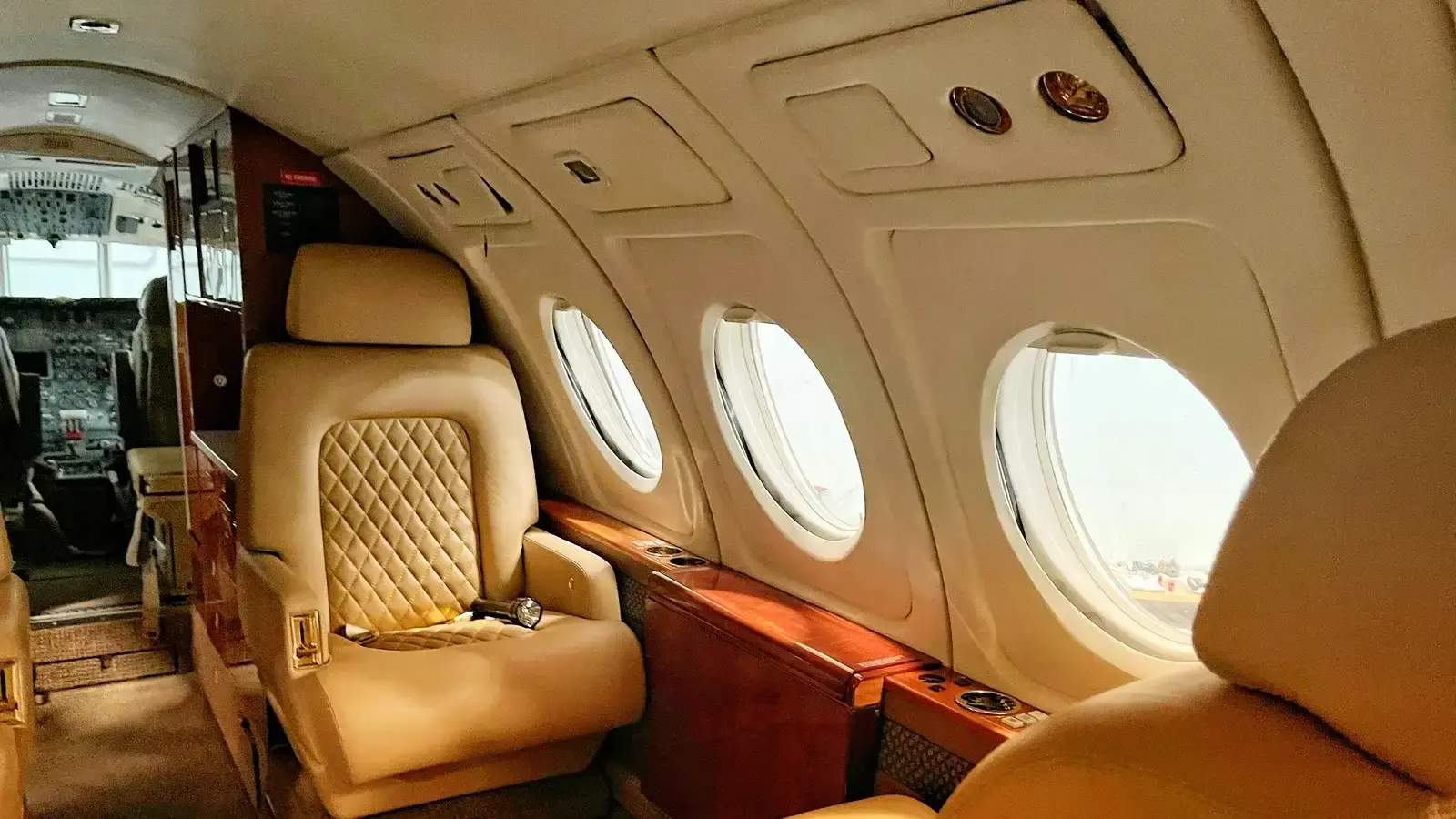
Not all jets in the same category are equal. A 15-year-old light jet and a brand-new one have very different cabin experiences, even if they cover the same route in the same time. Ask for the aircraft registration, its year of manufacture, the date of its last major service or refurbishment, and cabin configuration details. Check whether it has WiFi (satellite-based, not just text messaging), how much luggage space is available, and whether the lavatory is enclosed or simply a curtained area at the rear. If catering is important to you, ask what level is included — some operators provide gourmet catering while others offer sandwiches and snacks. For flights over three hours, cabin comfort details matter significantly more than on a quick one-hour hop.
📸 What to look for: Search the aircraft registration online to see photos of the actual cabin interior rather than relying on stock images from the broker.
Search empty-leg databases for savings up to 75%
Empty legs are repositioning flights that occur when an aircraft needs to fly somewhere without passengers — typically after dropping off a client or heading to pick one up. Operators sell these seats at steep discounts, often 50–75 percent off the standard charter price, because any revenue is better than flying empty. The catch is that availability is unpredictable and schedules can change at short notice if the primary booking is modified. Empty legs work best for flexible travellers who can adapt their dates and are comfortable with last-minute changes. Many brokers maintain real-time empty-leg databases on their websites, and some offer alert services that notify you when a leg matching your preferred route becomes available.
📸 What to look for: Sign up for empty-leg alerts on at least three different platforms to maximise your chances of finding a route match.
Understand every line in the quote
A private jet quote typically consists of several components beyond the base charter fee. Landing and handling fees are charged by the airports you use and vary enormously — landing at a small regional airport costs a fraction of a major hub. Fuel surcharges fluctuate with oil prices and can add 10–20 percent to the base price. Catering costs depend on the level you choose, from a basic cold platter to a multi-course hot meal prepared by a private chef. De-icing fees apply in winter and can cost over a thousand euros per application. Overnight fees apply if the crew needs to stay at your destination. Finally, ask about segment taxes and VAT, which vary by country and flight routing. A transparent broker will itemise every cost before you commit.
📸 What to look for: Request a final, fixed-price confirmation rather than an estimate — estimates can increase before departure.
Book with a credit card and verify the broker
Just as with villa rentals, paying by credit card gives you chargeback protection if something goes wrong. Never wire a large sum to an unverified broker. Before making any payment, verify the broker’s credentials: check their registration with relevant aviation authorities, look for membership in industry bodies like the Air Charter Association or NBAA, and search for independent reviews from previous clients. A reputable broker will have a physical office address, a verifiable track record, and named staff you can speak to directly. If a deal seems too good to be true — for example, a heavy jet at light-jet prices — it probably is. Scams do exist in the charter market, and due diligence on the broker is as important as checking the aircraft itself.
📸 What to look for: Ask the broker for references from previous clients and check their Companies House or equivalent business registration.
Confirm everything in writing 48 hours before departure
Two days before your flight, request a final confirmation document that includes the operator name, aircraft registration, departure airport and FBO (fixed-base operator) terminal, exact departure time, passenger manifest, luggage allowance, catering order, and ground transport arrangements at both ends. Confirm the crew’s contact number for the day of travel. Check that your passport details (and those of all passengers) have been submitted correctly, as errors can cause issues at immigration. If you are flying internationally, confirm whether customs and immigration will be handled at the FBO or at the main terminal. Arrive at the FBO 15–20 minutes before departure — one of the great luxuries of private aviation is the absence of long check-in queues.
📸 What to look for: Save the FBO address and phone number in your phone — FBO terminals are often in a different location from the main airport building.
Ready to Get Started?
Browse our trusted partners for the best rates and experiences.
Related Reading
Curated by Thomas Lovas Lokoy · Last updated: April 2026
From the Journal






Continue in this collection
Private Jets & Air Travel
Charter, empty legs and memberships — the hourly rate against what you actually pay.

Experiences & Activities
Charters, safaris and private islands — booking windows, and what the day rate excludes.

Travel Planning
Budgeting, insurance and concierge services, judged on what they do when a trip goes wrong.