
Private Jet Charter Cost in 2026: What You’ll Really Pay to Fly Private
The quote, the invoice, and the gap between them
Charter has no rate card, so the useful question is not what a jet costs but what a quote leaves out. Here is the cost structure line by line, real empty-leg prices read from a live feed, and the arithmetic that decides whether any of it is worth it.
By NorwegianSpark Editorial — written with AI assistance and reviewed by the NorwegianSpark SA editorial team.
There is no rate card, and that is the honest answer
There is no rate card, and anyone quoting you a single figure is guessing at your trip. Charter is priced per flight against aircraft category, flight time, where the aircraft has to come from, where it has to go afterwards, the airports at each end and the season. The only number that means anything is a written all-inclusive quote for your own route and date. This article used to open with hourly bands by aircraft class; they were unsourced, and on a page whose whole promise is honesty about money an unsourced band is the worst thing we could print. What follows instead is the structure of the bill, real prices read from a live feed on a stated date, and the arithmetic that decides the question.
What actually sits on a charter invoice
Every one of these lines exists on every charter. Whether it is inside the number you were quoted is the whole game, and the only way to find out is to ask line by line.
| Line | What it is | Why it moves |
|---|---|---|
| Aircraft and flight time | The core of the price | Category, cabin size and how long the sector takes |
| Positioning / ferry | Bringing the aircraft to you and taking it away | Where the aircraft happens to be, which you do not control |
| Landing and handling | Airport and FBO charges at each end | Which field you use; a quieter airport is not always cheaper |
| Crew costs | Duty time, overnight accommodation, subsistence | Whether the aircraft waits for you or leaves and returns |
| Aircraft parking | Standing charges while it waits | Days on the ground, and how busy the airport is |
| Catering | Anything beyond the standard load | What you order, and how far in advance |
| Taxes and duties | Varies by jurisdiction and flight classification | Where you depart, where you land, and how the flight is classified in law |
| De-icing | Winter departures only, billed at cost | The weather on the morning — nobody can price it in advance |
Ask which of these are inside the quote and which will follow. Treat any quote that will not answer as incomplete rather than competitive.
The number is per aircraft, not per person
Per aircraft, always. That single fact is what decides whether private aviation is extravagant or merely expensive: divide the aircraft price by the number of seats you can genuinely fill. A couple pays the whole aircraft between two; eight people pay the same aircraft between eight. It is why a family of six, a wedding party or a board travelling together reach a per-head figure that a solo traveller never will, and it is why the first question to ask about any private flight is not what does it cost but how many of us are going.
Empty legs, with real prices and real dates
When a jet drops off passengers and has to reposition for its next pickup, the operator sells that repositioning flight at a discount rather than fly it empty. Villiers, whose live listings we publish, describes the saving as up to seventy-five per cent against a standard charter. The trade-off is that the route, the date and the aircraft are all fixed by somebody else’s itinerary. Here is what that actually looked like when we read the feed on 6 September 2026, with the departure dates shown so you can see for yourself how short-lived these listings are.
- London Luton to Dortmund, departing 27 September 2026, a Citation CJ2+ with 7 seats, £5,536 for the whole aircraft. Filled, that is about £791 a person — our arithmetic, and it assumes you fill every seat.
- London Luton to Paris Le Bourget, departing 15 September 2026, a Pilatus PC12 with 6 seats, £6,987 for the aircraft. Filled, roughly £1,165 each.
- Farnborough to Nice, departing 17 September 2026, a Pilatus PC-24 with 8 seats, £18,113 for the aircraft. Filled, about £2,264 each — the same discount mechanism, a very different per-head answer.
- Madrid-Cuatro Vientos to Prague, departing 10 September 2026, a Citation Sovereign with 8 seats, €3,225 for the aircraft. Filled, roughly €403 each.
Read those four together and the pattern matters more than any one of them. The aircraft price and the per-head price are only loosely related, because the seat count and the sector length both move. The Prague leg is cheaper per head than a flexible commercial fare on some routes; the Nice leg is not cheap by any measure. Empty legs are not a discount on private aviation in general — they are a discount on one specific aeroplane going one specific way on one specific morning, and the skill is entirely in matching that to a trip you were making anyway. Prices and availability change constantly and every listing above will have gone by the time you read this. Our live empty legs page lists what is currently available. For how flexible aviation fits the rest of an itinerary, see the eight-step luxury trip framework, and for the aircraft themselves, the best private jets in 2026.
“Empty legs are not a discount on private aviation. They are a discount on one aeroplane, going one way, on one morning — and the whole skill is matching that to a trip you were already making.”
The catch nobody mentions until you have booked one
An empty leg exists because of a primary flight, and the primary flight has priority. If the client who created the repositioning changes their plan, the empty leg can move or disappear, and the further ahead you book one the more time there is for that to happen. Treat an empty leg as a very cheap flight that might not happen rather than as a cheap flight, and never build a connection, a cruise departure or a wedding around one. That is not a reason to avoid them. It is a reason to book them for the leg of a trip that can absorb a change.
Charter, membership or ownership
Charter is what most people mean by private jet: you book a single flight, you pay for it, and the relationship ends there. It is the most flexible option, the easiest to try, and the only one of the three that commits you to nothing. Membership and jet-card programmes sell guaranteed access and an agreed hourly rate in exchange for an annual commitment and a minimum number of hours. Fractional ownership sells you a share of a specific aircraft, which means a monthly management fee while you hold it and a residual value you eventually have to realise. We publish no annual figure or break-even hours count for either, because neither operator publishes a rate card and we hold no quote from any of them — VistaJet versus NetJets sets out how the two contract shapes differ and exactly which questions to put to each. For occasional flyers, charter plus patient empty-leg watching remains the clear winner.
Short-haul against business class, long-haul against sense
On routes under about three hours the time saving is real and it comes almost entirely from the ground. Consider Nice to London. Commercial: an hour to the airport, ninety minutes for check-in and security, a two-hour flight, half an hour through immigration, half an hour into town. Charter: twenty minutes to the FBO, ten minutes to board, ninety minutes in the air, five minutes to walk off, fifteen minutes into town. Those figures are an illustration rather than a measurement — your own numbers will turn on the airport, the traffic and the FBO — but the shape holds, and the shape is the point: on short sectors the saving is ground time, and ground time is where private aviation wins. On long-haul flights of eight hours or more the proportion inverts. The airborne time is the same on both, so the saving shrinks to that same fixed ground advantage while the cost difference grows with every hour flown, which is why long-haul is where the case for scheduled business class is strongest. The full comparison sits in private jet versus commercial first class. For where that budget might go instead, browse the best luxury travel destinations for 2026.

Who You Are Actually Buying From
This is the part of private aviation that first-time charterers almost never understand, and it matters more than the aircraft model. Most people arranging a charter are talking to a broker, not to the company that will actually fly them. The broker takes your requirement, shops it across operators and returns a quote. The operator holds the Air Operator Certificate, employs the crew and maintains the aircraft. Both are legitimate roles and a good broker genuinely earns their margin — but you should always know which one you are speaking to, and whose aircraft you are being sold. Ask, in writing, which operator will fly the aircraft and under which certificate. A broker who will not answer that before you pay a deposit is telling you something.
Why the invoice is bigger than the quote
Because a flight price and an all-in price are different products. Repositioning, landing and handling fees, crew overnight costs, aircraft parking, catering, applicable taxes and — in winter — de-icing can all sit outside a headline figure. Ask for an all-inclusive quote in writing and ask specifically how de-icing will be billed. That last one is the item that most often turns a good quote into a disappointing invoice, and no broker can price it accurately in advance because it depends on the weather on the morning. Ask how it will be billed rather than what it will cost, and treat any quote that ignores the question entirely for a northern-winter departure as incomplete rather than competitive.
How to Read a Charter Quote
Charter quotes vary in what they include far more than they vary in the flying itself, which is why comparing two headline figures is close to meaningless. Before you compare anything, get every quote onto the same basis:
- Is this an all-in price, or a flight price with fees to follow? Ask explicitly for an all-inclusive figure in writing.
- Which airports does it assume at each end? A smaller field near your destination can cost less to land at and considerably more to reach, or the reverse.
- Does it include repositioning — bringing the aircraft to you and returning it afterwards — and is that shown as a line or absorbed into the total?
- Are crew overnight costs included if the aircraft waits for you, and is aircraft parking charged separately?
- Which taxes apply and are they in the quote? Treatment differs by jurisdiction and by how the flight is classified in law.
- What are the cancellation terms, and at what point does the deposit stop being refundable?
- Is de-icing included in winter, or billed at cost on the day?
- Which operator is flying it, and under whose Air Operator Certificate?
When It’s Worth It
On short sectors with a group, into airports commercial airlines serve badly, or on an empty leg that happens to match a trip you were making anyway. For one or two people on a well-served long-haul route it almost never is: the airborne hours are identical, the ground saving is fixed, and the cost gap grows with every hour flown. Specifically, private aviation earns its price in these situations:
- Groups of four to eight on short-haul routes, especially to airports poorly served by commercial airlines
- Empty legs on routes you were planning to fly anyway, where the discount is not the reason for the trip
- Time-critical travel where a saving of a few hours genuinely changes what the trip achieves
- Destinations with limited or inconvenient commercial service — some Greek islands, remote safari strips, ski fields on a Saturday
- Health or mobility situations where a large commercial airport is genuinely difficult to navigate
- Multi-stop itineraries in one day, where the aircraft waits and commercial scheduling simply cannot do it
When It Isn’t
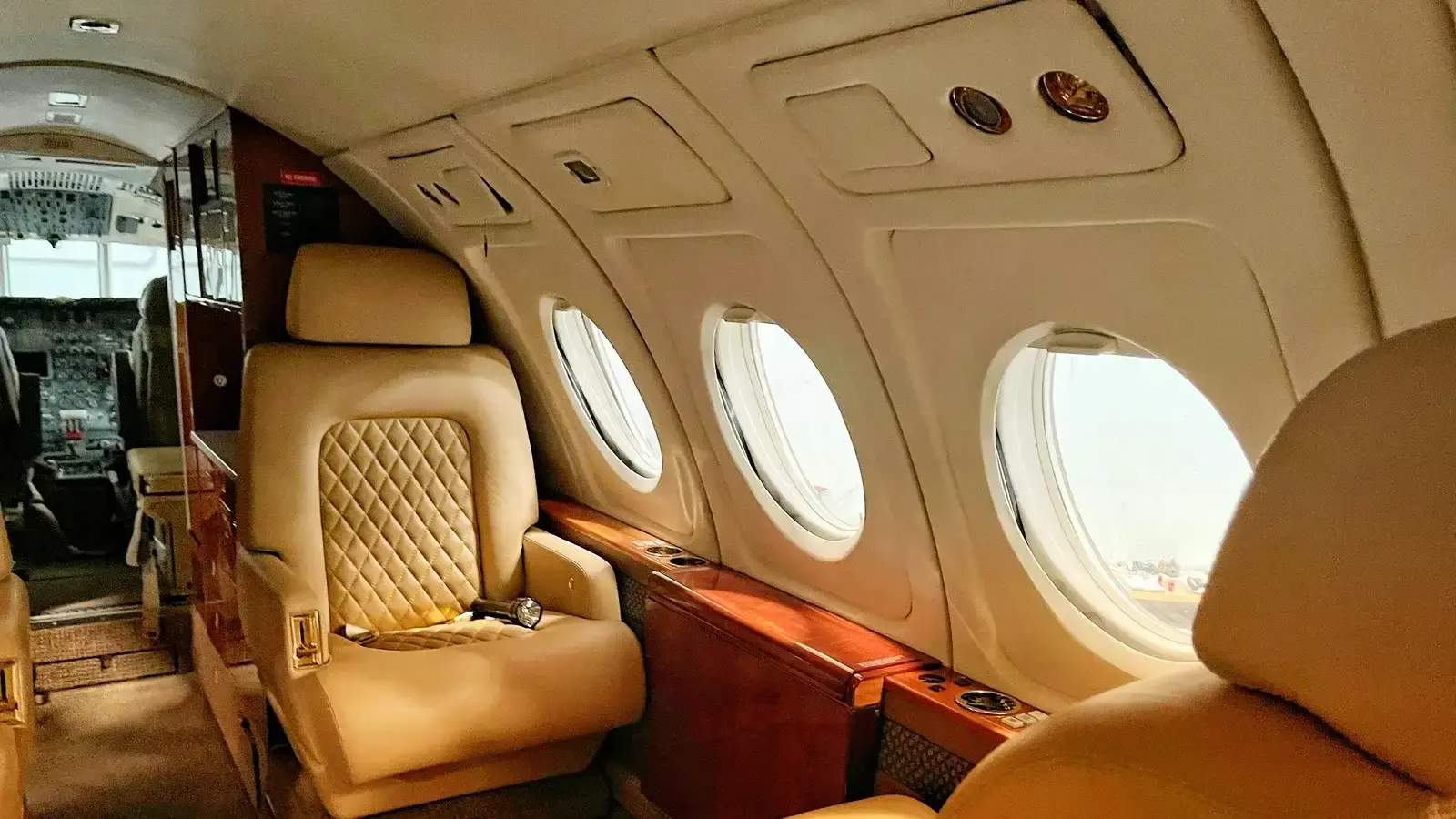
To be honest about it: most of the time, private aviation is not worth the money. A couple flying long-haul? Business class is better value and often a better product for sleeping. A solo traveller on a routine route? Not even close. The luxury marketing around private jets also oversells the experience. Light jets are cramped, catering is often mediocre unless you order well ahead, there is frequently no cabin crew at all on the smaller types, and turbulence hits smaller aircraft harder rather than less. The real luxury is the time saving and the airport experience, not the cabin itself. Spend the difference on the destination — a better villa, a private tour, a meal at a three-star restaurant. That is where the memories are made. If the ground experience is what you are actually buying, airport lounges and FBO and ramp-access transfers deliver a surprising amount of it at a fraction of the price.
Partner
Villiers Jets
On-demand charter and live empty legs across a broad operator network — request a quote for your own route and date.
Frequently asked questions
How much does it cost to charter a private jet?
There is no rate card, and anyone quoting you a single figure is guessing at your trip. Charter is priced per flight against aircraft category, flight time, where the aircraft has to come from, where it has to go afterwards, the airports at each end and the season. The only number that means anything is a written all-inclusive quote for your own route and date.
What is an empty leg flight?
When a jet drops off passengers and has to reposition for its next pickup, the operator sells that repositioning flight at a discount rather than fly it empty. Villiers, whose live listings we publish, describes the saving as up to seventy-five per cent against a standard charter. The trade-off is that the route, the date and the aircraft are all fixed by somebody else’s itinerary.
Is a private jet price per person or per aircraft?
Per aircraft, always. That single fact is what decides whether private aviation is extravagant or merely expensive: divide the aircraft price by the number of seats you can genuinely fill. A couple pays the whole aircraft between two; eight people pay the same aircraft between eight.
Why is the final invoice higher than the quote?
Because a flight price and an all-in price are different products. Repositioning, landing and handling fees, crew overnight costs, aircraft parking, catering, applicable taxes and — in winter — de-icing can all sit outside a headline figure. Ask for an all-inclusive quote in writing and ask specifically how de-icing will be billed.
Is chartering a private jet ever worth it?
On short sectors with a group, into airports commercial airlines serve badly, or on an empty leg that happens to match a trip you were making anyway. For one or two people on a well-served long-haul route it almost never is: the airborne hours are identical, the ground saving is fixed, and the cost gap grows with every hour flown.
A closing note on numbers. The only prices in this article are four empty-leg listings read from Villiers’ live feed on 6 September 2026 and dated in the text, plus our own division of each aircraft price by its seat count. No hourly rate, no aircraft-class band, no membership fee and no ownership break-even appears anywhere, because we hold no rate card and an unsourced figure is precisely the one thing a reader would act on. Get your numbers from a written all-inclusive quote for your own route. Reviewed by the NorwegianSpark SA editorial team.
Partner
Welcome Pickups
Private transfers with English-speaking drivers, arranged before you land.
Continue Reading
More from the Journal


Continue in this collection
Private Jets & Air Travel
Charter, empty legs and memberships — the hourly rate against what you actually pay.

Experiences & Activities
Charters, safaris and private islands — booking windows, and what the day rate excludes.

Travel Planning
Budgeting, insurance and concierge services, judged on what they do when a trip goes wrong.